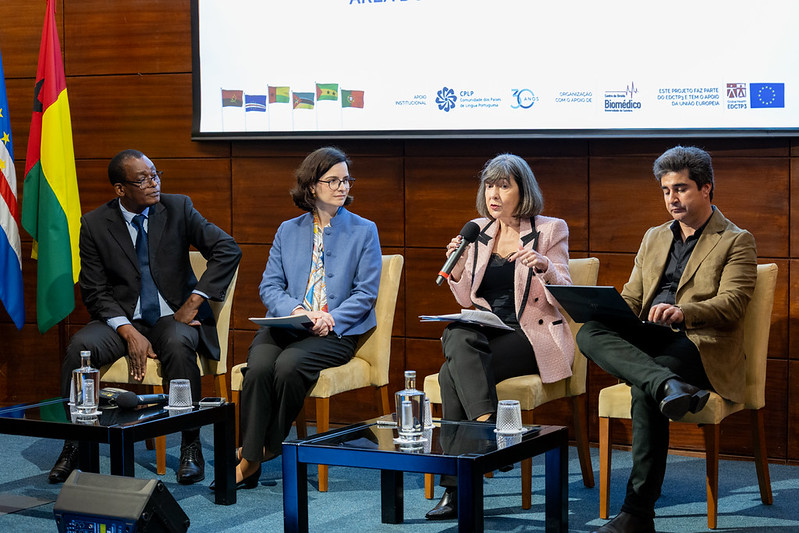
The harmonisation of rules for conducting clinical trials in the Portuguese-speaking African countries (PALOP) was the main theme of the Lusophone Workshop, which brought together experts from five Portuguese-speaking African countries as part of the CT-Luso Project on 11 March at the headquarters of the Community of Portuguese-Speaking Countries (CPLP) in Lisbon.
The Workshop, “Legal and Institutional Recommendations for Harmonisation in Clinical Trials”, presented the progress made over the previous six months and the plan for the following six months towards harmonising the legal and regulatory frameworks of Angola, Cabo Verde, Guinea-Bissau, Mozambique and São Tomé and Príncipe, with the aim of bringing their respective systems closer to international standards for biomedical research. The meeting consolidated a common understanding: regulatory harmonisation and institutional strengthening are key to attracting international research and ensuring high standards of protection for clinical trial participants in the PALOP.
CT-Luso Project Coordinators Hélder Mota Filipe and Maria do Céu Patrão Neves stressed that convergence can help establish an ethical and legislative framework aligned with international good practices, facilitating the conduct of clinical trials in different countries based on a single approved protocol. This model promotes collaboration between ethics and regulatory bodies to ensure higher quality and enable the same trial to be conducted in different contexts, adapted to diverse realities and geographical conditions.
Angola
The recommendations for Angola focus primarily on strengthening the conceptual and institutional framework of the Law on Clinical and Biomedical Research (Law No. 7/25). In particular, they propose strengthening the data protection framework by reinforcing confidentiality obligations and introducing the role of the Data Protection Officer (DPO).
Greater clarification of the rules on informed consent, the protection of vulnerable participants and the assessment of potential conflicts of interest is also recommended, ensuring that the Ethics Committee of the Ministry of Health is required to issue an opinion on these matters.
Finally, the recommendations call for the creation of a national database, managed by ARMED, for the systematic registration of clinical trials and related adverse reactions, while ensuring high standards of confidentiality and information traceability.
Cabo Verde
The proposed legislation in Cabo Verde requires further development of provisions concerning the assessment of the risk-benefit ratio in clinical studies, expressly providing for the possibility of reassessment throughout the course of the research.
In terms of governance and compliance, the recommendations call for stronger confidentiality and secrecy obligations in the processing of research data, in coordination with and complementing the existing data protection framework.
They also propose introducing the roles of monitor and auditor, which are essential to ensuring compliance with Good Clinical Practice, as well as creating a national database, managed by ERIS, for the detailed registration of clinical trials conducted in the country.
Guinea-Bissau
In Guinea-Bissau, the recommendations aim to provide greater systematisation and regulatory detail to the draft Code of Ethics in Health Research. One of the proposals is to include an article defining key concepts, such as sponsor and investigator, as well as to strengthen the principle of the primacy of human dignity, ensuring that participants’ rights and well-being always prevail over the interests of science or society.
Clearer regulation of the prior assessment of the risk-benefit ratio is also recommended, together with a reorganisation of the provisions on informed consent, with particular attention to the participation of vulnerable persons.
The recommendations further call for stronger confidentiality and data protection rules, including the introduction of the role of the Data Protection Officer, as well as explicit provisions on conflicts of interest. Finally, they propose the creation of a monitoring and inspection system for clinical studies, including mandatory assessment of conflicts of interest by CNEPS and the implementation of a national database, centralised by ARFAME, for the transparent registration of all clinical studies conducted in the country.
Mozambique
In Mozambique, the recommendations focus on improving the Human Health Research Law and its implementing regulations. In particular, they propose strengthening the safeguards associated with informed consent, including an explicit provision of the participant’s right to withdraw consent at any time, without prejudice or penalty.
The recommendations also call for the standardisation of urgent safety measures to be adopted by the sponsor and investigator in situations involving immediate risks to participants, ensuring prompt communication to the competent authorities, particularly ANARME.
To provide greater clarity regarding post-trial monitoring, it is also proposed that the Ethics Committee be given the authority to assess, whenever justified, the conditions for the clinical follow-up of participants after the study has concluded.
These improvements could be introduced through amendments to the Good Practice Resolution, as this would be a faster legislative instrument while awaiting approval of the organic statute and internal regulations of the National Bioethics Committee for Health.
São Tomé and Príncipe
For São Tomé and Príncipe, the conclusion is that the legislative framework currently being prepared is, in general terms, robust. Nevertheless, the recommendations call for the swift development of a specific legal instrument on clinical research to systematise, expand and complete the provisions currently dispersed across different instruments. This would include the introduction of key definitions, such as auditor, sponsor, participant and good clinical practice, as well as the explicit enshrinement of the principles of human dignity and participant protection in research.
Further legislative improvements should also address the protection of personal data, complementing the existing framework with specific confidentiality obligations in the context of clinical trials and the inclusion of the role of the Data Protection Officer.
The recommendations also call for the formalisation of mandatory conflict-of-interest assessments by CESIC, as well as the implementation of a national database, managed by ARFAMED, for the detailed and confidential registration of all clinical trials conducted in the country.
At the Lusophone Workshop, which was streamed live to partner Portuguese-speaking countries, the CPLP Executive Secretary, Ambassador Maria de Fátima Jardim, highlighted the importance of the CT-Luso Project and the central role of health, education and research in the socio-economic development of Member States. The current CPLP Presidency, represented by Counsellor Aviano Faria, from the Permanent Mission of Timor-Leste to the CPLP, referred to clinical trials as an essential instrument for innovation, access to new medicines and scientific capacity building.
At the closing session, the Permanent Representative of Portugal to the CPLP, Ambassador António de Almeida Lima, stressed the importance of civil society initiatives within the CPLP cooperation framework, such as the CT-Luso Project, which work in Portuguese to strengthen the capacity of countries in areas that are essential to their development.
The Lusophone Workshop was organised with the support of the Centre for Biomedical Law at the University of Coimbra (Portugal) and the institutional support of the CPLP. The project is funded by the European Commission through the Global Health EDCTP3 programme.