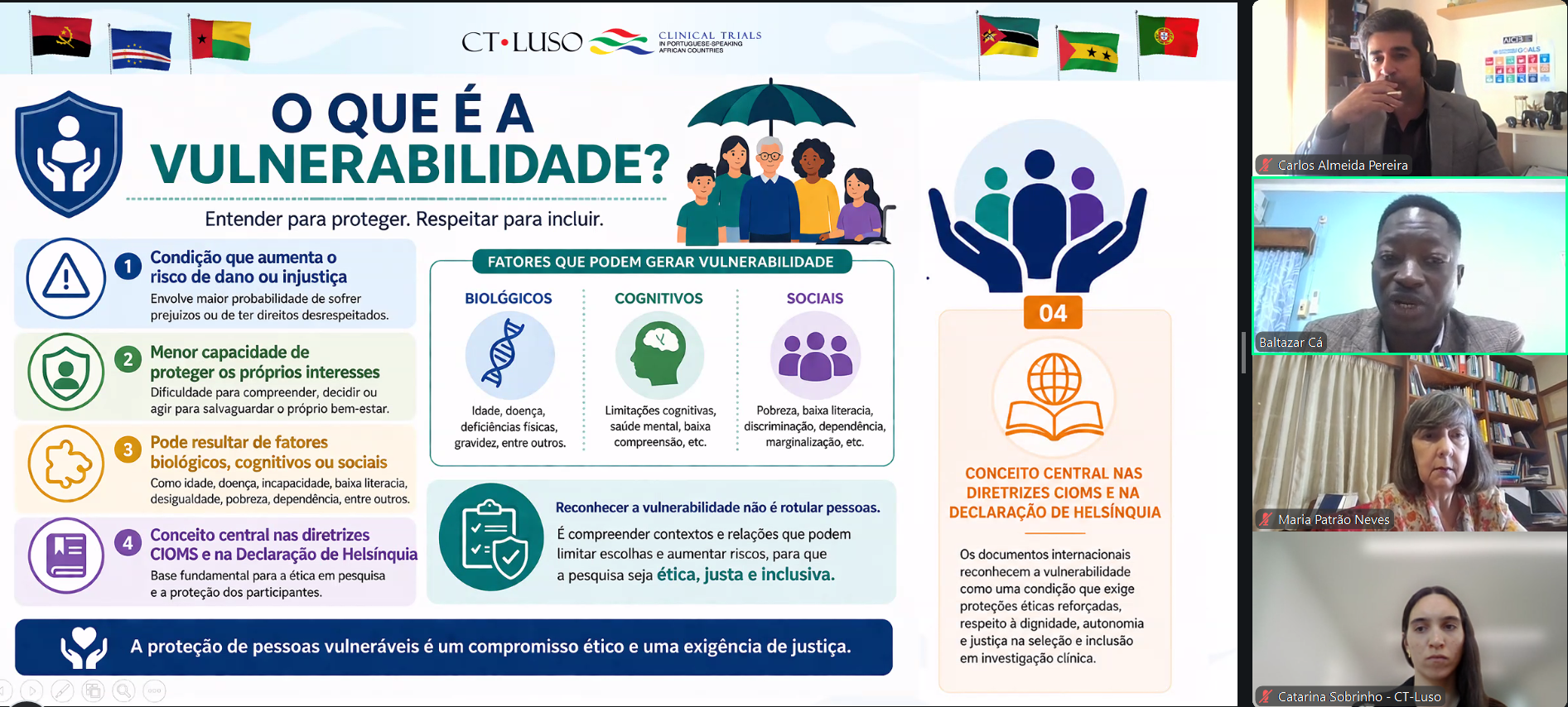
As part of the CT-Luso Project webinar series, the fifth session took place on 30 April, dedicated to the theme “Clinical Research Involving Vulnerable Populations”, bringing together around 50 participants from several Portuguese-speaking countries online.
The session was moderated by Carlos Almeida Pereira, Science Manager at the Agency for Clinical Research and Biomedical Innovation in Portugal, and focused on the challenges associated with including vulnerable groups in clinical research, highlighting the need to balance protection and participation.
Guest speaker Baltazar Cá, Researcher at the Bandim Health Project – National Institute of Public Health and the Lusophone University of Guinea-Bissau, stressed the importance of “protecting without excluding”, challenging historical practices that, until the 1990s, tended to exclude these populations from research, with an impact on the production of scientific evidence. It was emphasised that vulnerability should not be understood as a fixed label assigned to specific groups, but rather as a condition that may vary depending on the context and individual circumstances. In such cases, protection involves concrete measures, such as adapting information to participants’ level of understanding, using plain language, involving legal representatives when necessary, effectively checking participants’ understanding, and ensuring oversight by independent ethics committees. The aim is not to exclude, but to create the conditions for safe, informed and fair participation.
One of the central issues addressed was informed consent, understood not as a mere formal procedure but as an ongoing ethical process based on clear, comprehensible information adapted to participants, while respecting their autonomy, that is, their freedom to accept or refuse participation in research.
The session also identified specific challenges, including language barriers, cultural differences and low levels of health literacy, which require more tailored approaches. “We need to reflect on barriers, strategies and solutions for more inclusive and fair research,” said Baltazar Cá.
The specialist also noted that gaps or “legal voids” in some Portuguese-speaking African countries regarding clinical research should not compromise the protection of those involved. In such cases, protection should be based on international references, such as the [Declaration of Helsinki] and the [CIOMS – Council for International Organizations of Medical Sciences] guidelines, which establish ethical principles for clinical research. In this context, CT-Luso Coordinator Maria do Céu Patrão Neves highlighted the work being carried out by the project on [legislative recommendations] and the [harmonisation of legal and ethical frameworks among Portuguese-speaking countries].
The discussion also focused on the importance of community engagement, including dialogue with local leaders and participation in the design of studies, as well as transparency and the communication of results, as essential conditions for fairer and more relevant research. As emphasised during the session, which included an extensive discussion among participants, responsible inclusion is now understood as an ethical imperative: vulnerable populations should not be excluded by default, but included with proportionate safeguards and sound scientific justification.