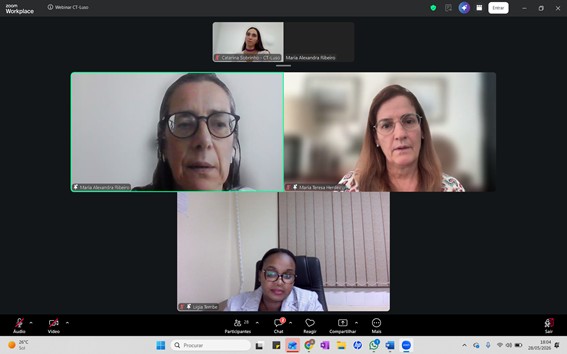
As part of the CT-Luso Project webinar series, a session dedicated to “Regulatory Affairs and Clinical Trials” took place on 29 May, bringing together participants from several Portuguese-speaking countries online to discuss the challenges and opportunities of regulatory harmonisation in clinical research.
The session featured a presentation by Maria Teresa Herdeiro, Professor in the Department of Medical Sciences and Researcher at the Institute for Biomedical Research, and was moderated by Lígia Tembe, Executive Director for Technical and Scientific Affairs at the National Regulatory Authority for Medicines of Mozambique (ANARME).
CT-Luso Project Consultant Maria Alexandra Ribeiro opened the session by highlighting the importance of sharing experiences and fostering cooperation between institutions to strengthen clinical research across the Portuguese-speaking world and develop more harmonised regulatory systems.
In her presentation, Maria Teresa Herdeiro highlighted the importance of regulatory affairs for patient safety and the quality of healthcare, stressing the need for effective systems to monitor the safety of medicines.
The specialist emphasised that clinical trials are a fundamental stage in the life cycle of a medicine, making it possible to assess its quality, safety and efficacy before marketing authorisation is granted. However, she also drew attention to some limitations inherent to these studies, such as the relatively small number of participants, age restrictions and the limited duration of exposure to medicines, factors that may make it difficult to detect rare or delayed adverse reactions.
One of the central topics of the presentation was pharmacovigilance, defined by the World Health Organization in the publication The Importance of Pharmacovigilance (WHO, 2002) as the “science and activities relating to the detection, assessment, understanding and prevention of adverse effects or any other drug-related problems”. The essential role of national and international systems for monitoring medicine safety was emphasised, as was the importance of cooperation between regulatory authorities, healthcare professionals and marketing authorisation holders in protecting public health.
The session also addressed the evolution of the regulatory framework for clinical trials, highlighting existing mechanisms for the continuous monitoring of the benefit-risk balance of investigational medicines and the importance of digital tools to support the management and monitoring of clinical trials, such as the [Clinical Trials Information System (CTIS)].
Another aspect highlighted was the need for continuous risk management throughout the entire life cycle of medicines, from clinical trials through to real-world use, drawing on different sources of information, such as spontaneous reports, scientific literature and epidemiological studies, to support informed regulatory decision-making.