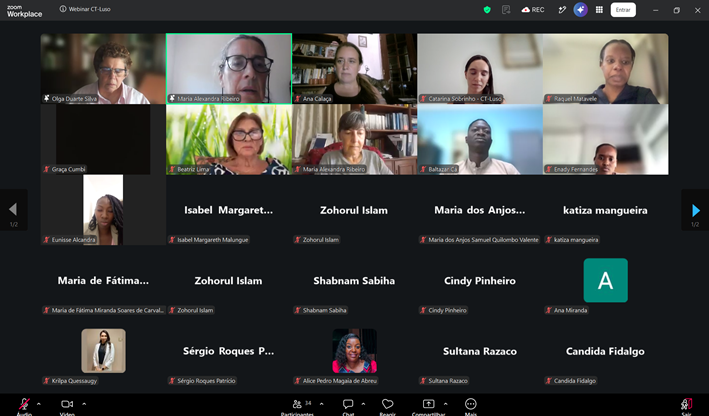
As part of the CT-Luso Project webinar series, a session dedicated to the theme ‘Biomedical Research and Traditional Medicines’ took place on 30 July, bringing together around 50 participants from several Portuguese-speaking countries and experts from Portugal, Angola and Mozambique to reflect on the value of traditional knowledge and its links with scientific research, safety and health innovation.
The session was moderated by Olga Silva, Professor of Pharmacognosy, Medicinal Plants and Phytotherapy at the Faculty of Pharmacy of the University of Lisbon and Chair of the Cooperation Council of the Portuguese Pharmaceutical Society.
The webinar featured contributions from Raquel Matavele Chissumba, Director-General of the Centre for Research and Development in Ethnobotany in Mozambique; Graça Cumbi, Head of Department at the National Directorate of Traditional and Alternative Medicine of the Ministry of Health of Mozambique; and Isabel Margareth Malungue, Head of the Department of Pharmacovigilance, Technovigilance and Clinical Trials at the Ministry of Health of Angola.
Isabel Margareth Malungue highlighted the work carried out by the National Health Research Institute in analysing plants used by the population, particularly the identification of their active compounds, the assessment of antimicrobial activity and the monitoring of potential contamination of products available on the market. She also stressed the importance of strengthening scientific research, pharmacovigilance and quality control mechanisms, noting that the Angolan regulatory authority is preparing specific regulations for traditional medicines and biomedical research in this field.
Graça Cumbi presented the policy and regulatory framework for traditional medicine in Mozambique, stressing that research projects must undergo ethical review and that the collection of plants and knowledge for scientific or commercial purposes requires the prior consent of communities. Despite the progress achieved, challenges remain, including limited funding, a shortage of qualified human resources and the need to strengthen research networks and joint projects capable of transforming existing knowledge into safe, effective and properly regulated products.
Raquel Matavele Chissumba focused her presentation on the safety and bioactivity of plants used in traditional, complementary and integrative therapies in Mozambique. She noted that around 70% of the Mozambican population relies on traditional medicine and stressed the importance of ensuring that its integration into healthcare is supported by scientific evidence. The speaker presented findings from studies on poisoning associated with medicinal plants, laboratory assessments of the toxicity of different species and the development of more accessible analytical methods adapted to the resources available in the country.
The session, which attracted active participation from the audience, therefore sought to deepen understanding of the role of traditional medicines in the health systems of the Portuguese-speaking African countries, highlighting the importance of biomedical research in assessing the quality, safety and efficacy of traditional practices and products. The discussion also addressed the challenges associated with integrating this knowledge into health policies, protecting traditional knowledge and developing research models that respect cultural contexts and the needs of communities.