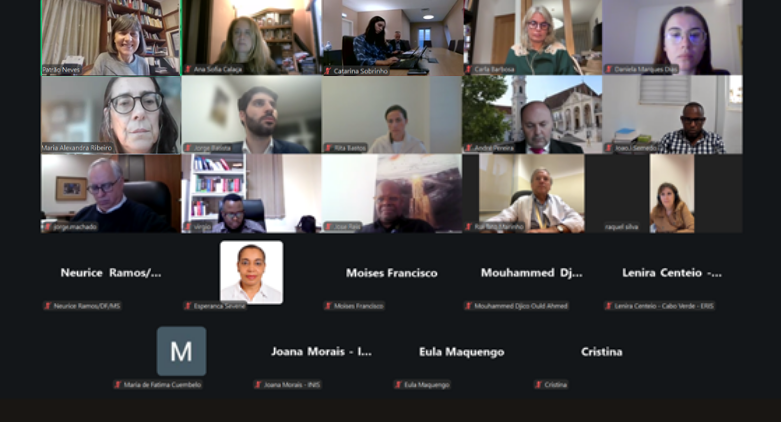
The monthly CT-Luso coordination meeting took place online on 5 November. The project coordinator, Maria do Céu Patrão Neves, reported that three sets of strategic documents had been submitted to the European Commission, including the Annual Report, covering activities carried out between September 2024 and August 2025; documentation templates aimed at harmonising procedures for biomedical research in Portuguese-speaking countries; and training materials supporting the topics addressed under Work Package 4, namely a Synopsis Manual for Fundamental Training and two infographics, one on informed consent and the other on regulatory matters.
The meeting also addressed the project's next steps, with a particular focus on Work Package 5, which will continue the training programme at a more specialised level. A total of 128 participants are expected to receive training, distributed among the countries according to the proportional representation of participating entities from each country in CT-Luso: 36 from Mozambique, 28 from Angola and Cabo Verde, and 18 from Guinea-Bissau and São Tomé and Príncipe.
Maria do Céu Patrão Neves also announced the launch of the CT-Luso webinar series, with the participation of the FAO Representative in Portugal. The first session, dedicated to food sovereignty, will take place on 19 November at 5:30 p.m. (Lisbon time).
The meeting also featured an intervention by the new President of the Commission for Clinical Research Ethics (CEIC), Rui Tato Marinho, who stressed that “the field of clinical trials involves many developments taking place across different disciplines, and it is increasingly important to recognise the value of ethics in clinical research.”
Carla Barbosa, from the Centre for Biomedical Law at the University of Coimbra, then highlighted the acceptance for publication of the article entitled “CT-Luso: Ethical and Regulatory Harmonisation of Clinical Trials in Portuguese-Speaking African Countries” by Cadernos Ibero-Americanos de Direito Sanitário, published by Fiocruz. She also announced that a new article is already being prepared, continuing the legal analysis initiated in the previous work.
The meeting also included contributions from Joana Morais (Angola), João Semedo (Cabo Verde), Mouhammed Djico (Guinea-Bissau), Esperança Sevene and Virgínio Uamba (Mozambique), and Eula Maquenbo and Hironísia Santos (São Tomé and Príncipe), who shared updates on progress towards legislative harmonisation, as well as on the Commitment Declarations and Partner Country Proposals, which aim to bring Portuguese-speaking countries into closer alignment with international best practices.