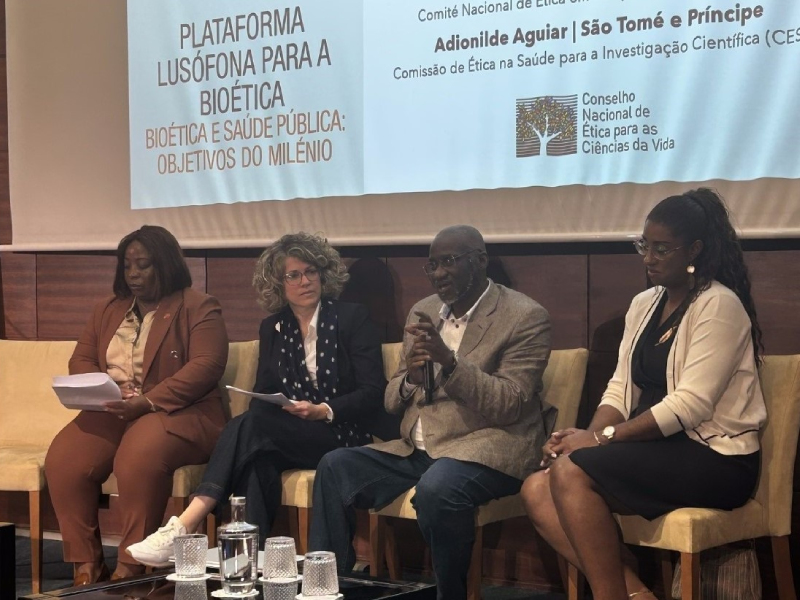
On May 21st, in association with the celebrations of World Portuguese Language Day, the National Ethics Council for Life Sciences (CNECV), in partnership with the Community of Portuguese Speaking Countries (CPLP), organized a roundtable on the theme “The dialogue between Science and Ethics in Portuguese: contribution of Ethics to biomedical research and clinical care". This session took place in the Auditorium of the CPLP headquarters, in Lisbon.
In the words of Professor Maria do Céu Patrão Neves, president of CNECV and coordinator of the CT-Luso project: “Ethics is today recognized as an absolutely decisive factor in the qualification of biomedical research and health care”. Maria do Céu Patrão Neves also highlighted that "a robust ethical-legal framework for biomedical research and, in particular, clinical trials, creates attractiveness for international investments which, in turn, favours the development of a scientific community in the country". He pointed out the need to stop the “brain drain”, one of the serious problems faced by Portuguese-speaking countries.
At the opening of the round table, moderated by Councilor Inês Fronteira, the professor also emphasized the mission of the Portuguese-speaking platform, created in 2022, to unite the community of Portuguese-speaking countries within the scope of ethics for Life Sciences.
Distinguished partners from the CT-Luso project participated in this round table: Ilda Jeremias, from the Institute of Health Specialization of the Ministry of Health of Angola, representing Guinea Bissau, Mouhammed Ahmed, from the National Committee for Ethics in Health Research (CNEPS), and Adionilde Aguiar, from the Health Ethics Committee for Scientific Research (CESIC) of Sao Tome and Principe. Throughout the debate, the various challenges facing CPLP countries in the context of clinical trials were addressed, such as the need for interdisciplinary dialogue, the consolidation of organizational structures, the applicability of approved legal instruments or the ethical review of protocols.
In the final notes, the vice-president of CNECV and President of the Center for Biomedical Law, André Dias Pereira, underlined that throughout the session several Millennium Development Goals were addressed - even if mentioned indirectly - such as the importance of healthy and quality education, climate emergencies, “a great challenge for bioethics”, water and sanitation management, “a great objective for all of us”, peace, justice and effective institutions, among others.